Development Process
RQML defines a five-stage development process that keeps requirements, design, planning, code, and verification in sync. Each stage produces a concrete artifact, and every artifact lives in version control beside the spec, so the why and how of a system are as durable as the code itself.
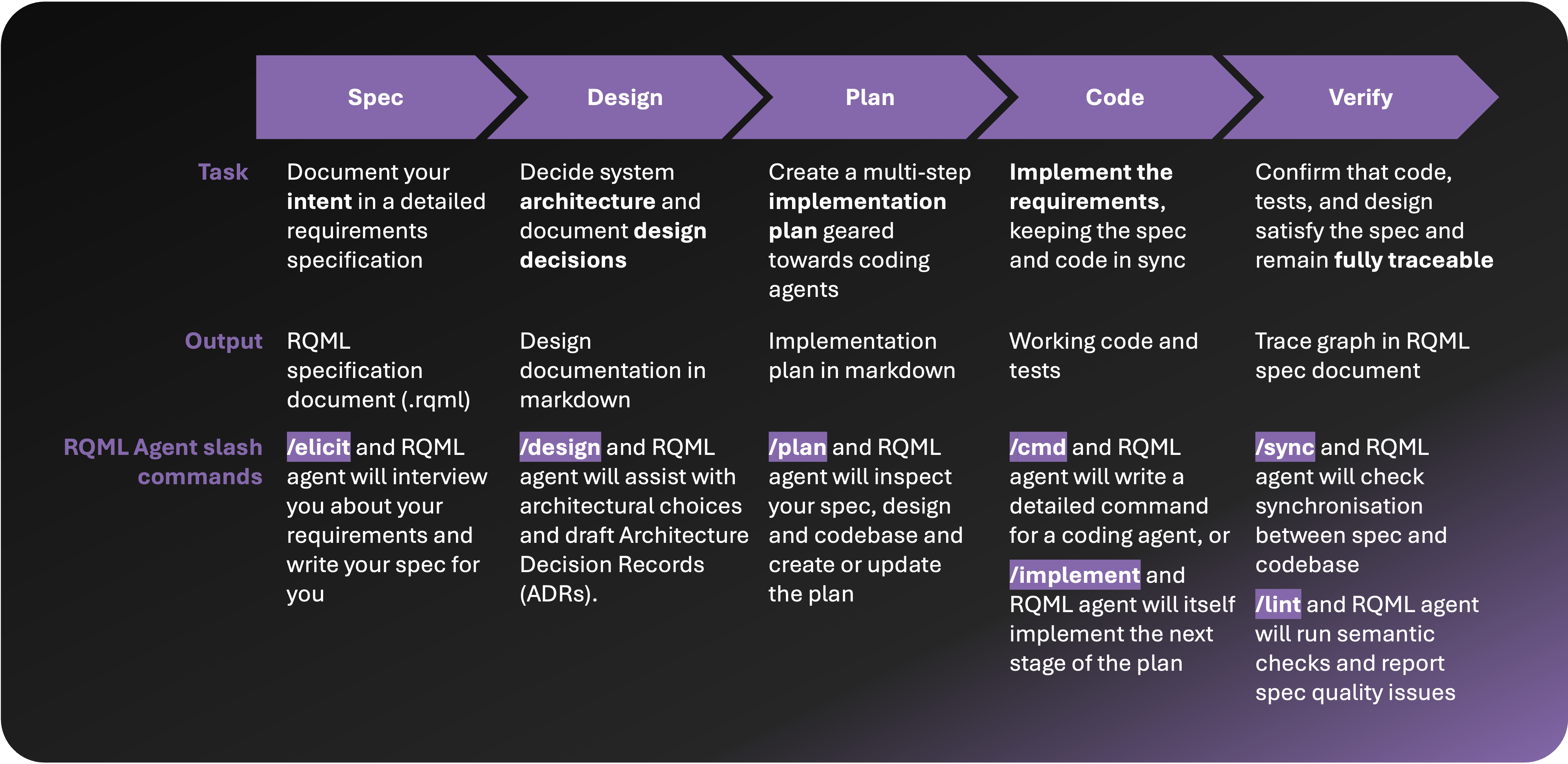
| Stage | Task | Output |
|---|---|---|
| Spec | Document your intent in a detailed requirements specification | requirements.rqml |
| Design | Decide system architecture and document the decisions | ADRs in .rqml/adr/ |
| Plan | Break the work into a multi-stage implementation plan for coding agents | .rqml/plan.md |
| Code | Implement the requirements, keeping spec and code in sync | Working code and tests |
| Verify | Confirm code, tests, and design satisfy the spec and stay traceable | Trace graph in the .rqml document |
The process is a loop, not a one-way street: verification feeds back into the spec, and new requirements re-enter at the top. The spec stays authoritative throughout — if code and spec diverge, you update the code or negotiate a spec change, never silently rewrite the spec to match the code.
The .rqml/ directory
Each stage's artifact lives alongside the spec:
project/
├── requirements.rqml              ← the spec (Stage 1: Spec)
├── .rqml/
│   ├── adr/                       ← architecture decision records (Stage 2: Design)
│   │   ├── 0001-auth-strategy.md
│   │   ├── 0002-api-versioning.md
│   │   └── 0003-database-choice.md
│   ├── plan.md                    ← the implementation plan (Stage 3: Plan)
│   └── baseline.json              ← drift baseline written by `rqml link`
└── src/                           ← code and tests (Stage 4: Code)
In monorepo setups, each spec gets its own .rqml/ directory, co-located with
that spec file, so a package's design and plan travel with its requirements. See
the Monorepo guide for how RQML decides which spec governs which
code, and how to check every spec at once.
The chain of reasoning
The five artifacts form one continuous, traceable chain:
- Requirements (
requirements.rqml) define the problem and acceptance criteria. - ADRs (
.rqml/adr/) record the architectural choices made to satisfy them, and why. - The plan (
.rqml/plan.md) breaks those choices into implementable stages. - Code implements the plan, traceable back to requirements and design decisions.
- Trace edges (in the
.rqmldocument) link code and tests to requirements, sorqml checkcan prove coverage and catch drift.
Code shows what was built and tests show what works, but only the spec and the ADRs explain why this, and not the alternatives. Keeping all five in the repository means that reasoning never decays into Slack threads and memory.
Driving each stage
The process is tool-agnostic — the artifacts and their locations are the standard; how you produce them is up to your tooling. Two layers help:
- The deterministic toolchain. The
rqmlCLI and the@rqml/mcpserver serve the middle of the loop —rqml overview/rqml matrixto survey the spec and its coverage,rqml showto read one requirement,rqml impactto assess blast radius,rqml approveto accept a requirement before it drives code,rqml linkto record a trace edge and its drift baseline,rqml gateto block implementation of a non-approved requirement, andrqml checkas the gate. No language model sits in any verdict. - RQML agent integrations. Editor and coding-agent integrations add guided, per-stage commands on top of those primitives — for example the VS Code extension and the Claude Code and Codex plugins provide commands to elicit a spec, record a design decision as an ADR, draft the plan, implement a stage, and run the gate. A well-behaved integration nudges you toward the next stage: ask to implement a feature that isn't specified, and it routes you back to Spec first.
Enforcement and strictness
How strictly the process is enforced scales with the project's declared
strictness level (set in AGENTS.md; the gate reads it):
| Strictness | Behaviour |
|---|---|
relaxed | Suggests the process but allows shortcuts. |
standard | Requires spec-first for features; core traces required. |
strict | Full traceability; all behaviour must be specified. |
certified | Audit-grade; formal approval expected at each stage. |
The deterministic gate (rqml check) enforces what it can compute — validation,
trace coverage, and implementation drift. Design and Plan adherence is guided by
your agent integration rather than gated by a model, keeping every blocking
verdict reproducible.
Next: Stage 2 — Design and ADRs · Stage 3 — the implementation plan.